
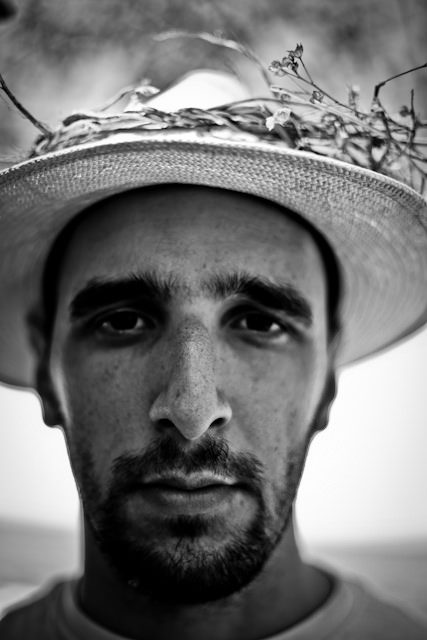
When I photograph someone at work, I have to decide how much of the room to keep. A close portrait gives me the face. Take a few steps back and there’s space for the person’s hands, what they’re working on, perhaps someone beside them. I like the point where you can still read the expression and begin to understand where you are.
What the room brings to a portrait
At home or at work, people have their own way of occupying a space. I’m interested in that. A horizontal frame gives me room beside the sitter. Turning the camera upright lets me keep a standing figure and the work in their hands while losing whatever is happening at the edges.


Colour can be a reason to keep some of that space. I look at where my eye goes first and whether the colour brings me back to the person. In black and white I look for a different relationship, often the way light falls across a face and continues onto the wall behind it.
How much direction to give
I borrow something from cinema here. I might give someone a small action or a situation to think about. It gives us somewhere to begin. Then I wait. I’m often more interested in the expression that comes as we start talking again, when the person has finished doing what I asked.
With a plain background, a small change in expression carries a lot of weight. That’s one reason I go gently with retouching. A line beside someone’s mouth can be the very thing that made me choose that frame.


Portrait books I return to
Jeanloup Sieff, 40 Jahre Fotografie

Helmut Newton, Portraits

Diane Arbus, An Aperture Monograph

Robert Doisneau, Portraits of the Artists

Vivian Maier, Self-Portraits



0 Comments